Showing posts with label 3d printing. Show all posts

Tuesday, July 21, 2015

Pigs for 3D Printing

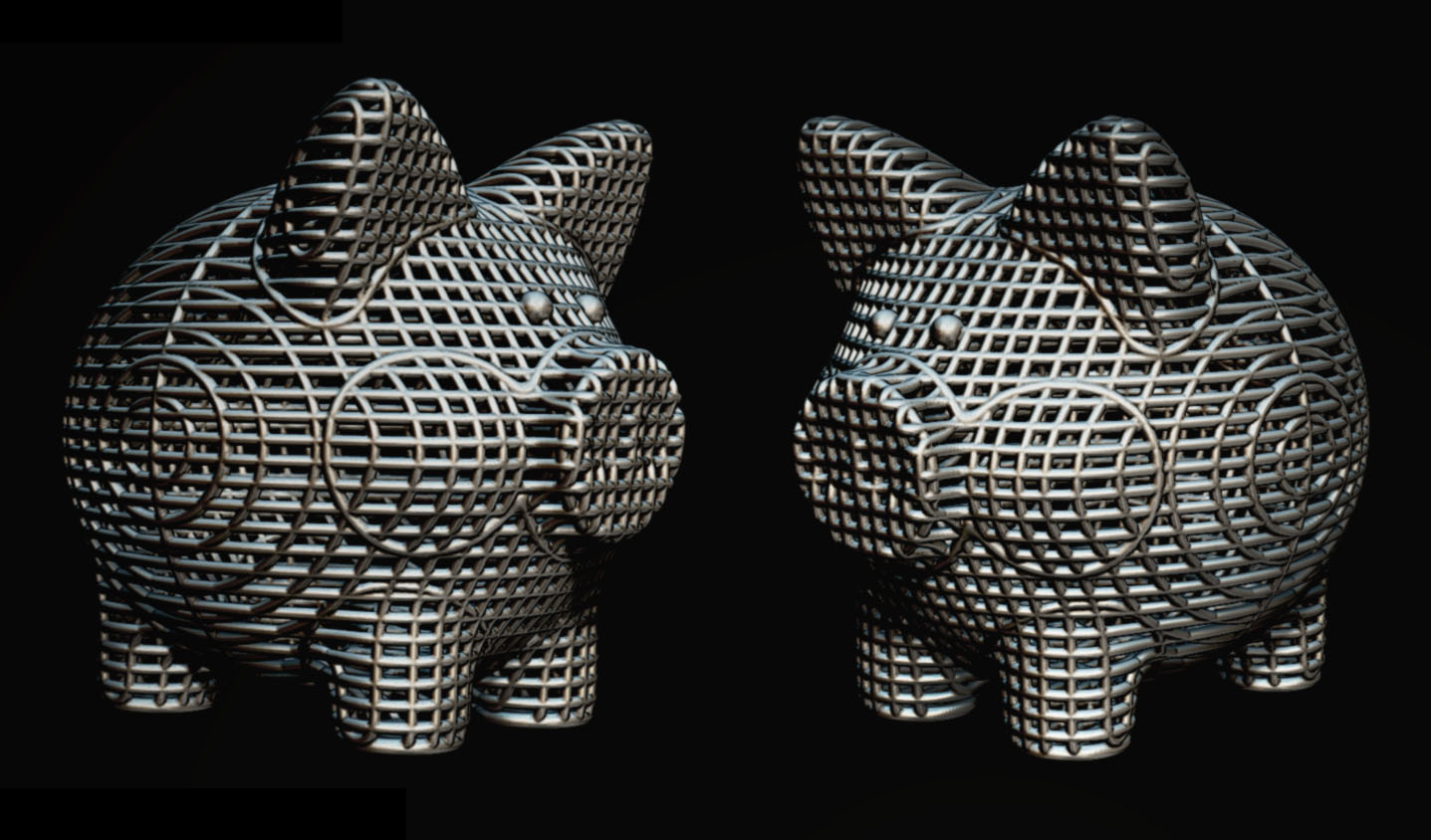
These two images are not photos. They are renderings generated in Keyshot and mark the end of my rendering models in Zbrush. I'll still be modeling in Zbrush  but, wow what a difference in the quality of the imaging.

I recently had a chat with a man about a pig. I can't really say much more on that other than it inspired me to create these little piggy banks for my pleasure and edification and perhaps a base mesh for relative future projects. The truth is that there have been plenty of pigs in my past. Large carvings, inflatables, fiberglass pattern models and molds. It would seem that my past is polka dotted with pigs. In My mind, the most famous pig aside from Porky and Ms. Piggy (pig's that I've never had the privilege to have worked on) is Pink Floyd's Pig balloon. As fate would turn out, I ended up working at the Macy's Parade studio with Scott Mcneil, the creator of that famed and emblematic rock and roll balloon from the years of my impressionable teendom. While I was with Macy's I would find myself involved with a plethora of pig projects and proposals. I carved a 7' long pig chasing a butterfly on his nose for Animal Planet. I sculpted balloon models, built their molds and did the casts for a 36' tall ballerina named Petunia and 70' long representation of Babe from the famed feature film. I've always been held a bit spell bound by the seemingly magical aspects of fashioning an object that can be held in my hands and having it enlarged to something as tall as an apartment building. Much of my career has been just
that, starting with a small sketch or mechanical drawing and making something outlandishly enormous but, in recent years I've begun exploring the opposite end of that spectrum. Working in 3d allows to to go one way as easily as the other. Just as I can scale a model to be robotically milled in sections and assembled to colossal proportions, I can as easily reduce the model and make tiny prints. This of course also translates immediately into cost reductions as well. When considering all of the pigs that I've done, I decided to create a little still life that would illustrate variations on a base theme in terms of detail, material, miniature scales, price points and production time. 3d printing is the only way to take this notion through to fruition and the light of day. I began by building the simplest pig possible. I would essentially start with a ball and then pull all of pigs features out of it. Once the simple, smooth model was done to my liking I began detailed variants not only for the sake of design but also cost analysis. I reasoned that by eliminating different
parts of the model, the printing costs would logically be reduced. This would lead to considerable hole cutting and then finally the wire frame variant. There was quite a bit of new learning involved in this. I've done a number of models for different projects that have involved the placement of rivets and bolts. In the past I've placed them all by hand, quite the tedious pain in the old gluteus maximus. In doing the Steampunk version I learned the the use and application of Zbrush's insert mesh tool. It allowed me to basically select any given polygroup and line it's edge with said bolts in 4 simple steps, an almost unbelievable time saver. in the process of that revelation I realized how I would accomplish building the wire frame version. By simply slicing the model along a grid, I would line the resulting polygroups with tube sections rather than bolts. I worked brilliantly. I sliced a copy of the model vertically and then sliced another horizontally. I separated the inserted meshes from their original polygroups and combined them to create the wire frame that you see in these illustrations. If you would like to be the proud owner of one of these new little piggies, please visit Shapeways website for a full assortment of sizes and materials ranging from 6 inches tall to 2 inches tall and, from vinyl to platinum. The prices range from as little as $6 to as much as $25,000.


                  As 'pig's ear' - Cockney rhyming slang for beer. 
                  As 'in a pig's ear' - an expression of disbelief. 
                  As 'make a pig's ear of ' - make a mess or muddle.

The following two images are derived from Shapeways renderings.


And now for the actual Shapeways prints...shot with my Iphone (and a bit of Photoshop).  The prints are all strong, white polished plastic (sintered nylon), 6 inches tall, about 7 inches long and 5 inches wide. They are actually the cheapest material that I could print them in. Despite the minor striation, I have to say that I'm quite delighted with the overall results. I could have gone with a more expensive material such as white acrylic. It's nearly 3 times as expensive but, the resolution is higher with less striation. It also sands and polishes very well. Nylon is not in love with being sanded as it's surface is much harder. Further, I wanted to keep the costs of this printing project under $500 for all 3 pigs. If I had gone with the Acrylic, the printing costs would have risen to over $1,300. If these 3 little pigs had to be perfectly painted and polished, Acrylic would be the obvious choice as cost difference would be more than offset by the reduction in finishing time. However, for proof of concept, the less expensive nylon serves nobly.

As I had mentioned earlier, I had reduced the surface area on 2 of the pigs not just to explore design variation but to reduce printing and material costs. When I submitted the Wire Frame pig, a price came back almost as high as the Steampunk design. I thought to myself, how could this be? I had removed pretty much half of it's surface and shell thickness. You would think that the logical answer would be that it should cost half as much. Logic loves to trick you with what you do not know. The cost of the print is determined not only by it's material use. It is also determined by the machine space that is occupied. The Wire Frame design only had a slot for coins, whereas the other two designs have large round opening though which a pocket full of change can easily by dumped. It also means that other models may be printed inside the pig. Thus allowing additional use of machine space that the slotted design wouldn't permit. I revised the design and replaced the slot with a larger round opening and the price came down to what I had originally anticipated.


Thursday, December 4, 2014

Charles Darwin Shapeways prints

This image above shows Charles Darwin printed as a 1 inch tall, nickel steel charm or pendant. As you can see, it's scarcely taller than a quarter. It is considerably grainier and more striated then the Shapeways renderings would suggest but, I have to admit that I love the effect. It seems more distressed and ancient than something fresh out of the 3d printer. In certain instances the striations mimic the hatch work in old engravings. When the 3d print arrived, it was quite a bit duller and darker as well. A few minutes of nylon brush and cotton wheel on the old Dremel tool brought the shine up in a jiffy while leaving the darker oxides in the deepest details. This piece is currently available at this link for under $30.
Shapeways is an online 3d printing service that prints in a variety of different plastics, metals and ceramic. The plastic prints are either SLA or SLS products depending upon the particular plastic. Most of the metal prints are actually printed in wax and investment plaster molded. The wax gets melted out of the plaster and is replaced with molten bronze. Once the bronze cools, the plaster is then broken off and the bronze may be hand finished.
Typically making a traditional or historical bust, an armature is first constructed, clay is applied and modeled, a silicone mold is built, the bust gets cast in wax, the wax is then refined and re-molded for bronze casting. It's a lot of steps and a lot of time. At the end of that laborious process you are left with one bronze in one size. This bust was sculpted in Zbrush, no armatures, no clay, no molds or casts. The different sizes are rather easily achieved by reprocessing the mesh to the desired dimensions. It's not quite as simple as just scaling it up or down. Consideration must be given to proper wall thicknesses. For instance,  the proportional wall thickness of the life sized head would be much too thin in much smaller variants. Conversely, the proportional wall thickness of the smaller variants once enlarged, without reprocessing would result in a needless use of additional material and expense. Fortunately Shapeways runs the mesh through it's own digital test and will alert you if the mesh needs modification in order to ensure the durability and success of the print.
The price range is nearly as astonishing as the available range of materials. A one inch tall head or bust in matte polished nylon can be printed on demand for as little as $5.25 or, for as much as $2,600.60 in platinum. My favorite finish is the premium silver for $130.31 but, the polished nickel steel is nearly as handsome and $100.00 less. An 18k gold version can be printed for $1,314.56 but a gold plated brass copy can be had for as little as $75.00. On the other side of the size spectrum, a life sized head can be printed for as little as $1,200.00 in polished nylon or, $8,986.66 in bronze. That may seem pricey to those unfamiliar with the costs of sculpting and casting an original portrait but, in truth it's never been more efficient or cost effective. While Charles Darwin may not be everybody's choice for an ear ring, charm or, pendant, anybody's portrait or head could be processed in this way.
Any loved one or, lover or, spouse or, child, anyone near, dear or, important to you can be commemorated and or celebrated in this medium. Beyond that personal but, miniature scope, The Darwin bust or head, especially in it's largest configurations would serve the collections and displays of any museum, library, school, office, scholar or, evolutionary biologist's study very well indeed.
Why Charles Darwin? He's a key hero in my pantheon of the greatest human beings whom have so rarely graced this planet's face. As a thinker he alone marks the begining of the begining with greater clarity, reason and rational resolve than any who came before him. His founding observations are the shoulders upon which all biological life sciences now stand.
While $127.90 may seem to many as a preposterous price for a 6" plastic Christmas ornament, it's actually peanuts for producing an on demand rapid prototype of an original sculpture. Besides, has there ever been a more serious looking Santa?

On a final note I must mention that while all of these images appear to be photographs, they are in fact based on renderings generated through Shapeways. Before making a purchase, I strongly suggest studying Shapeways site so that you may fully acquaint yourself with their products, methods and actual photographs of pieces in different materials that have been produced by them.

Wednesday, November 26, 2014

Sleigh and Reindeer for the 2014 Macy's Christmas Windows

5 Santa sleighs, 3 different sizes, 40 reindeer in assorted poses and scales for 5 of the 6 Macy's fabulous Christmas windows this year. I've been responsible for sculpting featured elements in these famous windows a number of times in the past. All of those elements were resin coated carved foam or solid cast resin. This project was a radical departure from those methods and materials. All of my sculpting duties in this were performed in front of my computer with Zbrush. For those unfamiliar, Zbrush is a state of the art modeling and texturing program originally developed for the movie and gaming industries. Virtually any shape can be created in it and, any virtual shapes can be made actual through 3d printing and robotic carving.
In the not so distant past, a project like this would require so many armatures and clay and tooling and resin and silicone and mold jackets and more resin and time and fingers absolutely sanded down to opened wounds. This was not that case. In this, everything was sculpted in virtual space. Different sizes and scales were simply achieved by rescaling the stereo lithography file (.stl).
The objects featured in this post (all shot with my Iphone!) didn't quite pop out of the printers the way that you see them here. Many components needed to be printed and assembled in parts and pieces and all of it was meticulously hand finished and beautifully hand painted by the talented art staff at Standard Transmission.
In the image below, Santa's reindeer seem to become smaller in perspective because they actually are smaller in reality. Descending scale is the oldest trick in the diminishing, forced perspective playbook. In the good old days this effect would require sculpting, molding and casting each reindeer individually. So gladly, this is no longer the case.

In it's largest example, the Santa's sleigh is about 3 and a half feet long. In Macy's Mars window, the sleigh sans runners is mounted on an actual radio controlled toy car chassis. On the other side of this CAD CAM (computer aided design/computer aided manufacturing) spectrum, with not much further development to the model, a life size or larger version could easily be carved by robots in rigid foams, of various densities. This is a very similar method to how the automotive and most transportational industries develop their vehicles. Considering all of that, it is easy to guess that this design and manufacturing technology will eventually make a leap from these wondrous Christmas windows into the Parade Studio. If that should come to be the case, floats and balloons would be sculpted in virtual space. Their components and pieces would be robotically carved or 3d printed on demand. Not only could full size floats and their myriad satellite components such as clown cars and push floats be created in this manner, window sized miniatures could be as well. In seemingly magical instances this would merge the Macy's Thanksgiving Day Parade and it's Christmas windows seamlessly. If Macy's renowned helium inflatables were designed this way, models could be printed in a staggering array of different materials and sizes as all of them are rather simple in terms of their shapes compared to the complex constructs of the the floats. Certain balloon models could actually be printed a couple of inches tall in a durable toy plastic. It would be a lovely thing for a client to hold in their hand while pondering their venerable venture. For not an unreasonable amount more, they could be printed in full color and in mass wherein all concerned parties in the design and production process have an actual full color miniature reproduction of the balloon. The communication issues that would be so well addressed by such objects doesn't need explaining.
  Recently I've been exploring metallic printing. Employing this process will allow me to recreate models in assorted metals ranging the gamut from stainless steel to platinum, with gold, sterling, bronze, and brass in between. The parade has an enormous fan base. Year after year, more than 3 million folks line New York City streets to be thrilled by the parade's unparalleled spectacle and grandior. Another 50 million people glue themselves to their television sets, transfixed by hours of NBC's award winning coverage of the parade. How many of those 53 million mentioned would love to have a gold or polished sterling silver pendant, charm or ear ring of their favorite balloon or float ranging from let's say $100 to $200? The amazing thing about this is that as the files are essentially derived from the original model, not only is it a proportionally perfect reproduction of the balloon, it could be put into jewelry production with almost no additional development costs. Further, as this is a process of printing on demand, the risk of over stocking a particular item that doesn't sell as well as another is greatly diminished and in terms of online shopping, no more pieces than are ordered would ever be produced.
Perhaps one of the greatest advantages of sculpting in the computer is the aspect of pre-visualization. All of the rendering are simply assembled screenshots of the model. At any point in the sculpture's development, such illustrations can be created in a few clicks, brought into Photoshop for assembly and adjustment and emailed to the client for approval. In instances where visual information is needed more immediately, I'll simply take a shot of my computer screen with my Iphone and text it to the client. If a client needs more information than the 3d renderings can offer, animated turn table movies can easily be provided as well.

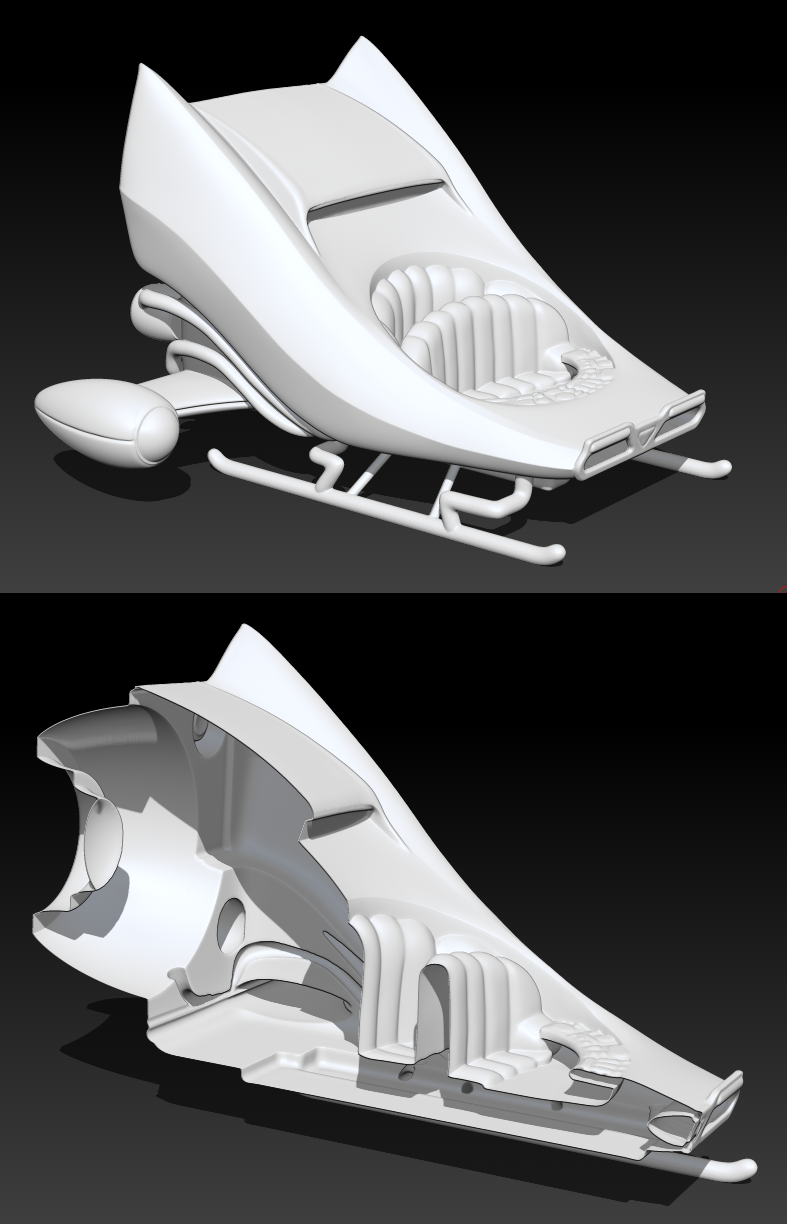
The illustration below shows the model in whole and in cross section with all of it's parts and subtools integrated into a single watertight mesh for 3d printing.
At an earlier point in the project's development a different rover design had been proposed but, was deemed rightly too complicated to animate each wheel independently. Though it wasn't used, I'm still quite proud of this model. The chassis floats on 6 swing arms with 12 pivot points, much in the manner of a marionette. It would also have required 6 individually wired motors and very precise mechanical mounting interfaces between the wheel and the hubs.


Monday, September 30, 2013

Octopus Monster Game Asset


This is the third asset for the game project. My client asked me for an Octopus monster to chase the Skycycle through the strange and twisted landscape. It had to be an Octopus but, it had to be fierce in a more than simply Octopus sort of way. There's quite an assortment of bits in this beast. A bit of dragon and dinosaur, a bit of croc and bug, claws like grappling hooks and a nightmarish mouth that you wouldn't want to kiss. I wanted the creature to be an iridescent green akin to a scarab but not as dark. I also had to maintain it's fleshiness so that it can breath and jet around once fully animated. It's easy to dream on creature amalgamation. A creature of this kind could see so many different variations.


In the video below we get to see the creature fly around the environment, which follows it's every move. The environment is actually a 2d still of the set tile wrapped around the inside of a sphere. Within that process, there are all kinds of shape surprises,

Thursday, September 26, 2013

Stephen Colbert Portrait, Bust, Cube X 3d Print


This little ABS bust of Steven Colbert is 6" tall and took about 13 hours to print, at medium infill and resolution on the Cube X. Like the other Cube X prints, this wasn't my first attempt. I contacted Cubify support and asked for advice. They told me to try a smaller medium resolution print set to medium density without detail preservation. I gave it a shot and this is what I got. I applied painter's tape to the build plate and then applied Magic Glue to the tape. It seemed to work but, an hour or so into the print I notices that while the ABS was sticking to the tape it was also curling with enough force to pull the tape away from the build plate. As I've read more and more, it seems that the only way to get consistent, undistorted ABS prints ( that actually stick and don't move around)is to invest in a heated build plate. They cost about $500. Ugh. Aside from the distortion in the lower part of the pedestal (will be corrected with sculpt epox) its a fairly remarkable print. It didn't come out of the machine looking like this however. I've put 6.5 hours into finishing this and could easily put another 4 or 5 hours into it before it would be ready for molding. Most of the support material did simply snap off with the exception of the scaffold supporting the chin. That bit of support required some radical carving in order to get to the intended forms beneath it. There were also two areas of this print that were a step out of register, one, through the center of the pedestal and, two, across the shoulders and through the center of the necktie's knot. They required a fair share of finessed carving and sanding to hide. All of that Said, ABS is a lovely plastic to work with. It carves and sands out very nicely and the majority of its striations can be buffed out with acetone. In fact, when applied sensitively, acetone can buff this plastic out to a finish that very closely resembles polished marble.


SHOCKING NEWS FLASH!!!... STEPHEN COLBERT COMES OUT OF THE CLOSET AND OPENLY CONFRONTS HIS INFLUENCE ON THE MARIJUANA NATION. FOR MORE IN DEPTH DETAILS ON THIS GROUND BREAKING STORY AS IT UNFOLDS, PLEASE CLICK HERE!

Monday, September 23, 2013

Game Environment Set Tile


The difference between microcosms and macrocosms is contextual. The difference between miniatures and monuments follow the same suit. Visually its a matter of placing the viewer on a sliding scale that can either put them inside of the scene with its elements towering above them a la' Honey I Shrunk the kids or, outside and above wherein the scene is simply a strange and tiny tile littered with an eruption of fantastic fungi.


Each element within the tile is a separate set piece that can be individually edited, textured, distorted, scaled or, rearranged. In order to create a continuous loop for the Skycyles to fly through, the tile is copied and rotated to present a different entrance aspect of the scene than the first tile. The rotated duplicate tile is then placed after the first tile to effectively double the length of the set. Since the Set Tile has 4 elevation sides, this process can be repeated 4 times before an image or point of view is repeated.


As these scenes represent an early stage of development, not much has been done with texturing yet and in truth I'll be sorry to obscure some of the beautiful, stretched polygon patterns but, it'll be all the more mind blowing textured as striated desert stone.


Many more Set Tiles have been discussed, mecha tiles, ruins tiles, tunnel tiles and the like. In the end, a mosaic of interchangeable set and scene transitions will be created.


In the animation the shapes get pretty crazy as they go sweeping past on the turntable. I can't wait to see tiny Skycycles flying through it from different points of perspective.